

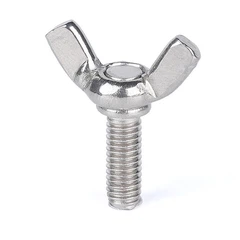

Basic Knowledge Of Screws
Dec 10, 2025
Leave a message
Terminology Related to Screws
Differences between screw, nut, bolt, machine screw, and stud:
According to standard terminology, "screw" and (luómào) are not formal terms.
"Screw" is a common term referring to any fastener with external threads.
A "nut" typically has a hexagonal shape with an internally threaded hole, used in conjunction with a bolt to fasten related components.
(luómào) is a colloquial term; the standard term is "nut."
A "bolt" usually has a hexagonal head and a shaft with external threads.
A "machine screw" is smaller, with heads that may be flat or cross-shaped, and a shaft with external threads.
A "stud," more accurately called a "double-ended stud," has external threads on both ends and typically an unthreaded shaft in the middle. The longer threaded end is used to connect with deep holes, while the shorter end is used with a nut.
Common English terms:
Screw / Bolt / Fastener
Definition of threads:
Threads are uniform helical ridges on the external or internal surface of a solid object.
Functions of Threads
Fastening and Connecting: Applicable to most screw products currently in use.
Transmission (Displacement Function): For example, micrometers used for dimensional inspection in quality control.
Sealing Function: Such as sealing connections in pipelines.
Send Inquiry